Normative case studies open up conversations on Harvard’s legacy of slavery and other difficult subjects
By Nicole Rura | October 27, 2026
“What supports do we, as members of the Harvard community, need to feel comfortable discussing difficult topics, like Harvard’s legacy of slavery?”
As the Report of the Presidential Committee on Harvard & the Legacy of Slavery was under development in 2020 and 2021, Meira Levinson and Martha Minow, members of the Presidential Committee on Harvard & the Legacy of Slavery and members of the Presidential Committee’s subcommittee on curriculum, wanted to know how to best help the Harvard community and beyond to learn about, process, and respond to the Report’s contents.
Levinson, who was at the time the Juliana W. and William Foss Thompson Professor of Education and Society at Harvard Graduate School of Education, and Three Hundredth Anniversary University Professor Minow dispatched HGSE graduate students Orelia Jonathan and Caroline Tucker Mehta to ask a cross-section of the University’s students, staff, faculty, and alumni that question.
“People responded that they didn’t want to be lectured at, made to feel guilty, or be engaged in performative exercises,” said Levinson, who is now the Chen Family Educational Foundations Professor at Stanford Graduate School of Education. “They wanted to engage in complex ways that will necessarily make the participants vulnerable. How do we do that well?”
With the goal of fostering collegial on-campus conversations about Harvard’s legacy of slavery and other topics, Levinson and her team began to create a portfolio of “normative case studies,” scenario-based discussion resources publicly released later in 2022.
This week, Levinson’s team released two new normative case studies: “To Teach or Not to Teach?,” which presents a professor weighing whether to include Huckleberry Finn on his syllabus; and “Visual Veritas,” which debates how Harvard’s historical leaders should be memorialized on campus. The creation of all the Harvard & the Legacy of Slavery-related normative case studies was funded in part by the Radcliffe Institute for Advanced Study with additional support from the Harvard & the Legacy of Slavery (H&LS) Initiative.
“In each normative case study, we try to make each perspective as legitimate and defensible as possible, which increases the opportunity for serious, empathetic engagement with multiple perspectives,” said Tucker Mehta, who co-authored several normative case studies with Levinson and is currently a doctoral candidate at HGSE. “And we carefully design the normative case studies to ensure that participants are unable to ‘know’ who they’re supposed to identify with or what stance they’re supposed to take. There aren’t any villains or straw men or women who are there for the purposes of knocking them down.”
Opening Conversations
Levinson and her team use facilitated, difficult conversations to boost awareness of ethical issues affecting school systems or other learning environments. She developed normative case studies more than a decade ago as an educational tool that could provide a safe path into those hard discussions.
Levinson initially created numerous normative case studies about ethical situations that educators can face in K-12 schools, such as promotion or retention of a struggling student, social media and discipline, and standardized testing.
These brief but detailed scenarios present multiple, somewhat conflicting perspectives about a realistic and challenging ethical question.
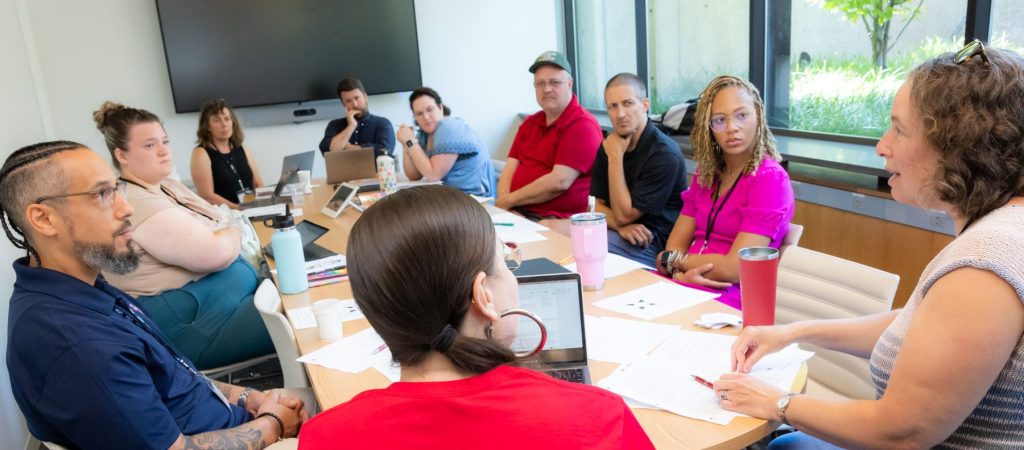
During a normative case study session, the facilitator sets the norms and discussion rules for the session. The participants then take a few minutes to read through the normative case study or a few participants present the normative case study to the entire group by reading roles in a “reader’s theater.” Following the reading, the facilitator guides a discussion of the characters’ various perspectives, with a focus on ethical or policy issues.
“Normative case studies focus not on grand values, but on really concrete questions of policy or practice,” said Jonathan, who also co-authored several normative case studies with Levinson and is currently an adjunct lecturer at HGSE. “Almost paradoxically, that focus on concrete questions makes it easier for people to discuss competing values or interpretations of a value.”
The normative case studies have been used to open up dialogue across the Harvard community, from alumni groups to students contemplating their House names to staff and administrators seeking more effective conversations with each other and the students they serve.
Having Difficult Discussions
In mid-September 2022, Levinson implemented the first H&LS Initiative’s normative case study, “A Forced Reckoning,” with 90 of Harvard’s Division of Continuing Education staff and administrators who regularly gather to discuss how to support DCE’s highly diverse student population.
This normative case study describes fictional Harvard students’ varied perspectives on whether the University has a responsibility to teach about its historic ties to slavery, and whether students have a responsibility to learn about it. The topic was specifically chosen because it was a practical opportunity for attendees to engage with the Report’s findings and hone skills that are useful for engaging with people who have different experiences or opinions.
Following the meeting, participants said they were grateful for how “A Forced Reckoning” created a dedicated space for having difficult discussions and for learning how to create that space in their conversations with each other and DCE students.
“The normative case study provided us with a model for how to have challenging conversations,” said Thomas Maldonado-Reis, assistant director of enrollment requirements at DCE and a participant in the “A Forced Reckoning” discussion. “For example, before all of our regular sessions, we still use the norm setting that Levinson conducted at the beginning to ground us in a conversation together.”
Hearing the Other Side
Normative case studies have also helped students living in the same residence feel heard, which can be critical for co-existing and fostering a healthy community.
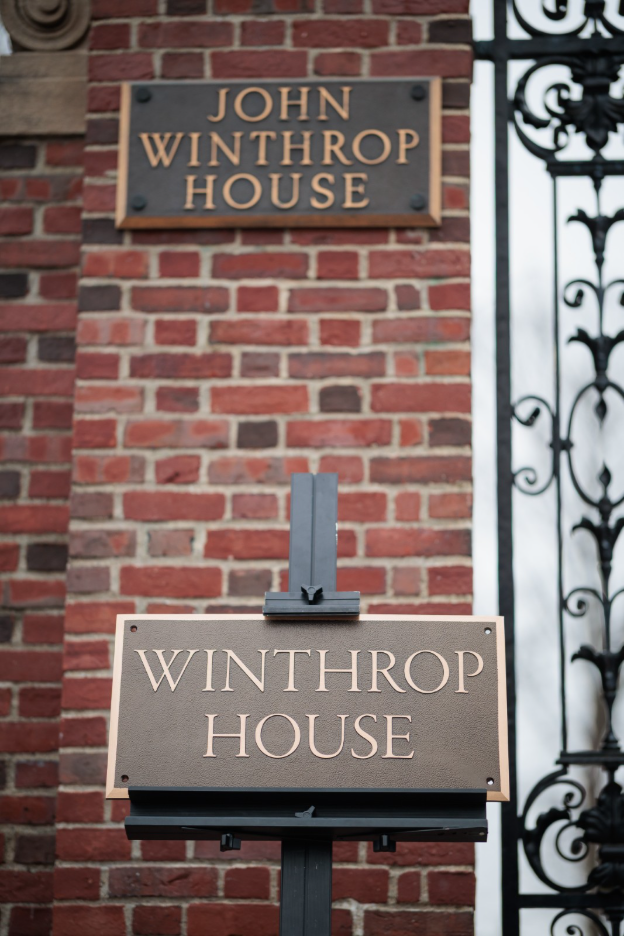
For several years, the community around John Winthrop House, including current students and alumni, had been discussing the complicated legacies of the House’s namesake, Professor John Winthrop, who is described in the Report as one of the Harvard leaders and faculty members who “enslaved people.”
Opinions within the House ranged between passionately in favor of removing John Winthrop’s name from the House, strongly against changing the House’s name, and some feeling like they did not have enough information or background to form an opinion, according to Mamfatou Baldeh, a resident tutor at Winthrop House and HGSE graduate student.
To encourage residents to contemplate and discuss the arguments for and against changing the House’s name, Baldeh facilitated a normative case studies discussion called “What’s in a Name?” in Winthrop’s senior common room in November 2023.
This normative case study centers around a fictional college community grappling with its name because the namesake’s family had a multigenerational history of enslaving people and profiting from the slave trade.
Baldeh said that the normative case study’s design was important because the hypothetical situation allowed students to put distance between themselves and the ethical issues posed during the discussion.
“Having arguments attached to fictional people was helpful for all of us to see that this issue is more complex than just: you’re in support of this history or you’re not,” said Baldeh. “Using the case study, we could neutrally look at this hypothetical school’s situation and then allow that to lead us into a deeper discussion of the ideas that the residents came in with about Winthrop’s name.”
After a group of Faculty of Arts and Sciences affiliates petitioned the University to remove Winthrop from the House’s name, a Review Committee was formed to consider the request and submit a recommendation on whether to keep the name, remove the name, or keep the name and contextualize it.
In July 2025, based on research into the House’s namesake and the Winthrop family, the Review Committee recommended retaining the “Winthrop” name but removing the name “John”, as a “… chance to reflect on an entire family, whose contributions to Harvard and to the country will no doubt be mixed but nevertheless will have substantial positive connotations.” President Alan M. Garber and Dean of the FAS Hopi Hoekstra accepted this recommendation, and going forward, the undergraduate residential House will be formally known as Winthrop House.
Academia’s Responsibilities
In her Fall 2024 general education course, “The Social Responsibilities of Universities,” Julie Reuben used the “A Forced Reckoning” normative case study to spark thoughtful discussions among the 86 undergraduates in the class. According to Reuben, who is the Charles Warren Professor of the History of American Education at HGSE, the students debated about the subjects that academic institutions should teach – and higher ed students should learn – during their limited time on campus.
“My students talked about to what extent students need to understand their institution’s involvement with slavery, how information about that history should be disseminated, and whether learning about it should be required,” said Reuben. “I thought the normative case study was very effective. I’m looking forward to using ‘A Forced Reckoning’ again the next time I teach this class in the Fall of 2026 and would recommend other faculty use normative case studies when they can be integrated into a course’s syllabus.”
According to Levinson, participating in a normative case study discussion can create the framework and skills for more constructive dialogue about other tough topics.
“After experiencing a normative case study, participants have said they feel okay expressing disagreement with one another and asking each other questions that they might not have felt comfortable asking before, because they realize they could disagree and still be friends,” said Levinson. “If you give people the tools and the safe space for difficult discussions, we can open up dialogue on so many potentially divisive issues.”