Working together shifts fellows’ trajectories and enriches their mentors’ core research
By Nicole Rura | September 29, 2026
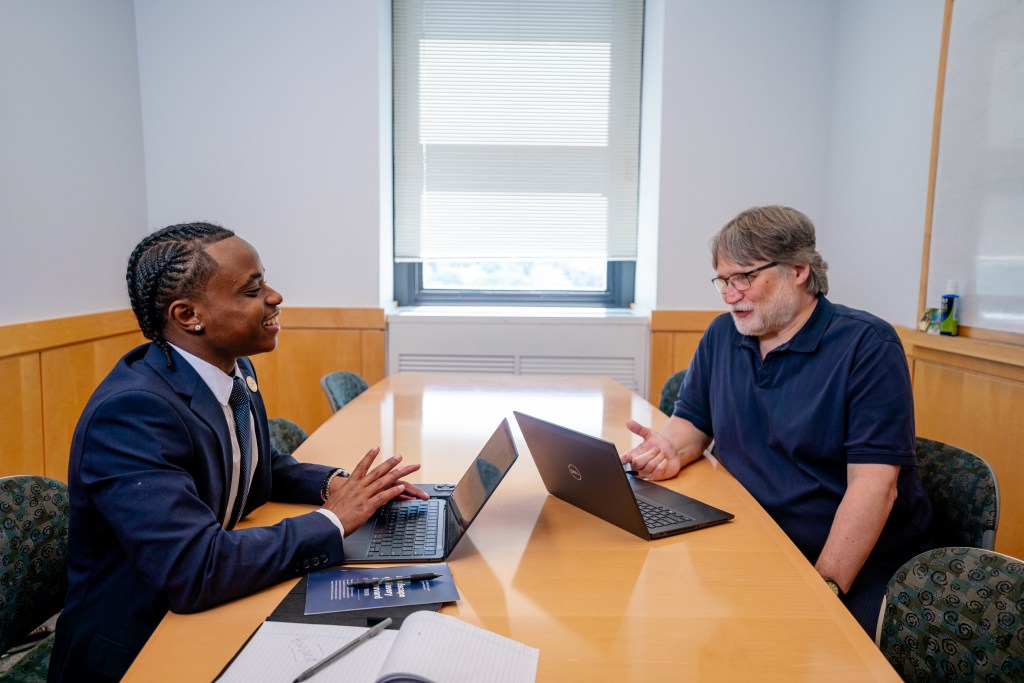
The Du Bois Scholars Program’s one-on-one mentoring between Harvard faculty and undergraduate fellows from historically Black colleges and universities (HBCUs) can shift fellows’ thinking about research or even the direction of their careers. At the same time, the fellows’ perspectives have influenced how faculty think about their own work.
Wrapping up its third year, the Du Bois Scholars Program fulfills a goal outlined by Recommendation 3 in the Report of the Presidential Committee on Harvard & the Legacy of Slavery; the program creates opportunities for students from HBCUs to conduct summer research alongside Harvard faculty mentors. The Harvard & the Legacy of Slavery (H&LS) Initiative launched the Du Bois Scholars Program and provides comprehensive oversight and strategic direction for the program.
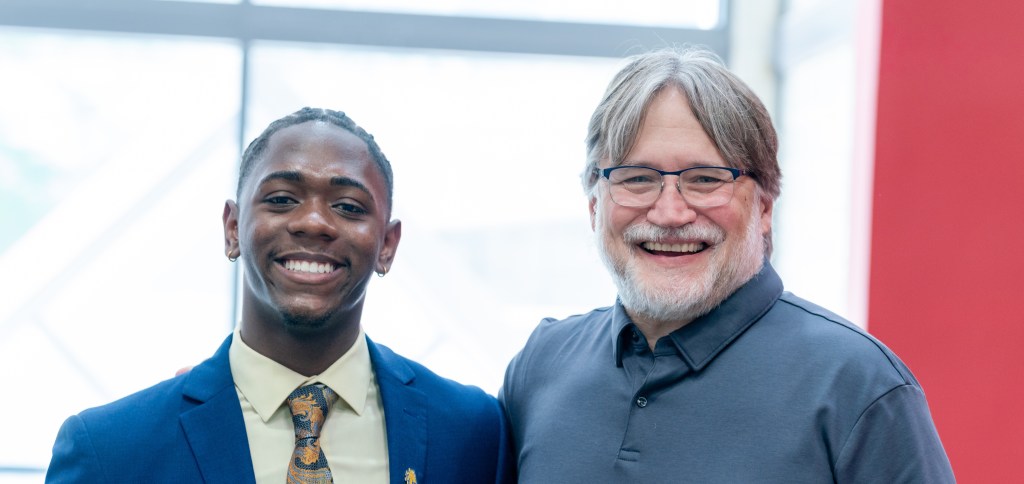
The H&LS Initiative recently spoke with one of the program’s faculty mentors and two of his most recent past fellows about the program, mentorship, and the importance of following one’s passion. Gary Adamkiewicz, associate professor of environmental health and exposure disparities at Harvard T.H. Chan School of Public Health, has mentored four fellows since the program launched in 2024. We spoke with two: Derrick Bradley, a junior at North Carolina Agricultural and Technical State University who worked with Prof. Adamkiewicz in the summer of 2026, and Joseph Carter, a senior at Texas Southern University who worked with Prof. Adamkiewicz in the summer of 2025. This interview has been edited for clarity and length.
INITIATIVE: Prof. Adamkiewicz, who and what helped shape your path from engineering school to associate professor?
ADAMKIEWICZ: I’m trained as a chemical engineer, but I felt the calling of public health as I completed my PhD. I really wanted to find a place that was a good fit for my interests, skills, expertise, and even my lived experience. Growing up, my family lived for a few years in one particularly bad apartment in Queens with an awful cockroach infestation, and those first-hand experiences inform my work even today.
The first time all of my interests and expertise came together was when I was a postdoc for Jack Spengler, who recently retired. He was the reason I came to Harvard Chan School. At the time, he led a project called the Healthy Public Housing Initiative. We were motivated to figure out why 25% or more of the children living in Boston Housing Authority developments were diagnosed with asthma. That percentage was incredibly high – almost three times what the U.S. Centers for Disease Control and Prevention reported as the rate for kids nationwide at that time.
Since then, I’ve shifted my core research to identifying the specific aspects of housing and communities that shape an individual’s health. These could include environmental exposures to smoke, chemicals, mold, or extreme heat, for example. That research is used to directly inform policies that create healthy and sustainable cities and housing.
Before I joined Harvard Chan School, I had some mentorship experiences that were like, “This is the way things are done.” That approach didn‘t work for me, so now I encourage students not to just focus on “the rules” or the paths that other people have taken. Where can they use their skills, curiosity, lived experiences, and passions to solve important problems?
INITIATIVE: Derrick, what part of Prof. Adamkiewicz’s research did your fellowship focus on?
BRADLEY: Initially, Prof. Adamkiewicz suggested that my research project this summer focus on how extreme heat can impact indoor cooling strategies. I’m double majoring in landscape architecture and liberal studies [at North Carolina Agricultural and Technical State University], so I asked if I could use my background to look at how access to green infrastructure, like tree canopy coverage and parks, affects older adults’ ability to cope with high temperatures. Prof. Adamkiewicz said that he’d love me to pursue this because my perspective could help his research in the long run.
INITIATIVE: Joseph, how did Prof. Adamkiewicz’s mentorship help you during your fellowship?
CARTER: I’m a political science major with a minor in psychology [at Texas Southern University], and Prof. Adamkiewicz was very open to answering questions about anything – from what life is like in Boston to my research interests and how to conduct research.
I had a mycotoxin attack in 2022 – a really bad reaction to mold where I was living. When I was diagnosed, I was in the ER because I was very dehydrated from severe gastrointestinal issues. That experience got me very curious about the effects of mold exposure on the human neuroimmune system and our ability to function in society.
After discussing my interests with Prof. Adamkiewicz, we switched my topic from the Healthy Public Housing Initiative. Instead, I analyzed more than 200 research papers on mold and its effects on people’s bodies. And I wrote a paper, “Sick Homes and Silent Minds, Uncovering the Neuroimmune Impacts of Mold in Under-resourced Communities,” to help average people understand what mold can do to the body.
INITIATIVE: Prof. Adamkiewicz, you work at Harvard Chan School, a graduate school. Why do you mentor undergraduates?
ADAMKIEWICZ: Most undergrads know the paths to become a doctor, a lawyer, or an engineer, but they may not know about public health. Expanding the experiences and viewpoints in the field of public health is a good thing, and that process starts with getting undergrads interested.
INITIATIVE: Derrick and Joseph, beyond those initial conversations about your research projects, how did Prof. Adamkiewicz’s mentorship affect you?
BRADLEY: At first, I saw Prof. Adamkiewicz as someone with more experience, wisdom, and expertise in public health. But throughout the program I saw that he genuinely wanted to help me, wanted me to succeed, and pushed me towards greatness. I could express myself fully, including by sharing my reservations. Those moments anchored me and helped me internalize that I’m here for a reason, and I can be great.
CARTER: My fellowship opened a whole new world for me because I realized that I didn’t need to follow the same, straightforward, narrow path that a lot of people are on. I’d been planning to go straight to law school after graduation, but now I’m going do something that feels more aligned with my values. I’m applying to several programs, including the Fulbright Program, the Rhodes Scholarship, and the Schwarzman Scholar Program, because I want to study abroad and see how I can better serve the global community.
INITIATIVE: How do you think Prof. Adamkiewicz’s mentorship style has affected your approach to mentoring others?
CARTER: Texas Governor Greg Abbott appointed me to Texas Southern University’s board of trustees as student regent, which is the highest serving student position at the university. As I mentor and engage with other students, I hope to embody a leadership style similar to Prof. Adamkiewicz’s—one that creates space for people to express their ideas openly, encourages them to explore diverse paths, and empowers them to pursue the opportunities and ventures that are most meaningful to them. I want others to feel the freedom to define success for themselves rather than simply following the path that has been prescribed for them. Time passes quickly, and when you look back 10 or 20 years from now, you should be able to say that you spent those years pursuing something you genuinely loved and found purpose in—not simply doing what others told you that you should be doing.
The Du Bois Scholars Program will open its application for 2027 this fall. Subscribe to Harvard & the Legacy of Slavery Initiative’s Community Newsletter to receive timely information about the next application cycle.