
Seminar trains and supports HBCU business faculty who introduce the case method to business students, while Harvard learns about HBCU faculty and student needs
By Nicole Rura | November 20, 2025
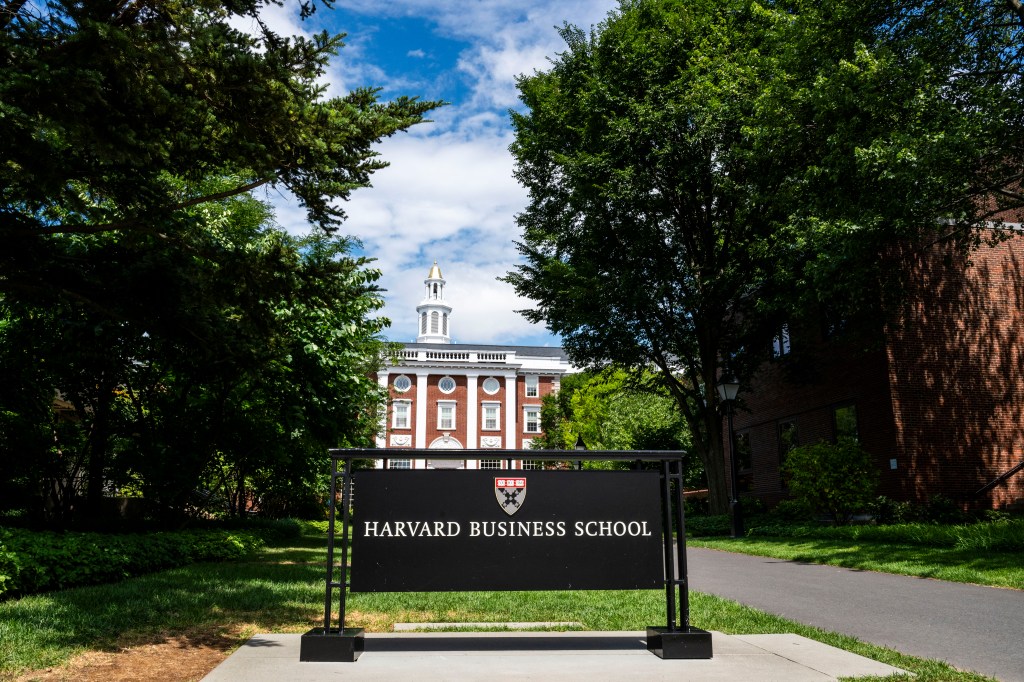
The second annual Teaching with Cases seminar for historically Black colleges and universities’ (HBCU) business faculty recently wrapped up on the Harvard Business School (HBS) campus. Led by Harvard Business Impact (HBI) in collaboration with the Harvard & the Legacy of Slavery (H&LS) Initiative and HBS, the seminar trains HBCU professors and instructors who want to use case studies as a teaching tool in their business classes.
Case studies offer detailed, real-world scenarios designed to put students in the shoes of protagonists who are dealing with complex business situations that require difficult managerial decisions. During classes taught using case studies, students tease apart the cases’ dilemmas and discuss how they’d approach any decisions. When students’ perspectives differ, they learn from each other while the professor or instructor guides the conversation.
“Case discussions allow students to gain practical experience making difficult decisions in the safety of a classroom before they are tested in real situations with real ramifications,” said Lucy Swedberg, the executive editor of HBI. “But professors integrating the case method into their classrooms need support and training to make it most effective.”
The concept of a Teaching with Cases seminar for HBCU business faculty started when Swedberg and Carin Knoop, the executive director of HBS’s Case Research and Writing Group, spoke at the HBCU Business Deans Roundtable Annual Summit in 2023. At the Summit, Swedberg and Knoop heard from deans of HBCU business schools who wanted to provide robust training and professional development opportunities for their faculty. Yet sustainably supporting such initiatives was often challenging.
From those conversations, HBI created the HBCU-specific course that is based on HBI’s general Teaching with Cases seminar. Each installment of the seminar for HBCU business faculty has had about 60 participants who are nominated by HBCU deans to attend the two-day program.
“We keep the seminar to about 60 participants so that the seminar classroom functions like a true case-method classroom,” said Sandra Barber, the associate director of educator training and development at HBI. “With that number, there’s enough diversity of perspectives to spark rich discussion, but it’s still an environment where everyone can actively participate. The size fosters a sense of community and trust, which is especially important in giving HBCU and Harvard faculty space to talk openly about the opportunities and challenges that are unique to HBCUs.”
The seminar was a true melting pot—one of those rare and powerful moments when voices from HBCUs, Harvard, and institutions across the nation come together to build relationships, family, and community.
Derrick Warren
Learning the case method
The first business-focused case study was developed at HBS in 1921. In the following years, professors at the School began integrating the case method into their syllabi, and today, the School’s teaching methods heavily rely on case studies. Although cases are potent pedagogical tools, their presentation requires different skills than lecture-based teaching methods.
“Teaching with case studies is a distinct challenge,” said Mary O’Leary, senior manager of educator training and development at HBI. “Business professors are often practitioners first, and they may not have formal training in facilitating lively, focused discussions or in engaging the full range of perspectives in the classroom. Developing these essential skills takes practice, and many instructors thrive when they have support and guidance to bring the case method to life.”
During the seminar, participants are taught how to facilitate an effective discussion of a case study in class, including choosing the case, outlining a plan for the class, and asking the right questions. Participants also hone skills for encouraging all students to get involved in the discussion, as well as navigating student responses.
HBI maintains an expansive catalog of more than 35,000 case studies that are used by HBS and 4,000 educational institutions in more than 75 countries. The case studies are based on information gathered from onsite research at businesses or from publicly available sources. Since their inception, cases have been incorporated into the programs of numerous business schools around the world.
Adding case studies to the HBCU curriculum
The collaboration between HBI, HBS, and the H&LS Initiative is part of the H&LS Initiative’s ongoing commitment to developing enduring partnerships with HBCUs as recommended in the Report of the Presidential Committee on Harvard & the Legacy of Slavery. The Report acknowledges that Harvard, like many other institutions of higher learning, benefits from the scholarship of HBCU alumni. HBCUs have been crucial in producing professionals, leaders, and changemakers who make significant contributions to society. The HBCUs’ accomplishments are achieved despite having endowments one-seventh that of non-HBCUs and while enrolling twice as many Pell grant-receiving students as other institutions, according to UNCF.
For Derrick Warren, the dean of the College of Business at Grambling State University and one of the 2024 program’s participants, a highlight of the seminar was working together with other HBCU faculty to focus on how best to support their students.

“The seminar was a true melting pot—one of those rare and powerful moments when voices from HBCUs, Harvard, and institutions across the nation come together to build relationships, family, and community,” said Warren. “The leading practices from Harvard were not only amplified but elevated by the rich, diverse, and unique perspectives in the room. Our cohort was a remarkable convergence of great minds united by purpose.”
The conversations and exchange of ideas between those “great minds” benefit everyone involved, said Sara Bleich, the vice provost for special projects and leader of the H&LS Initiative.
“The Teaching with Cases program exemplifies how Harvard and HBCUs can share knowledge with each other,” said Bleich. “While the participating HBCU professors learn about implementing the case method—an important pedagogical tool—in their classrooms, their perspectives help HBS learn how to introduce cases to new audiences at HBCUs.”